Abstract
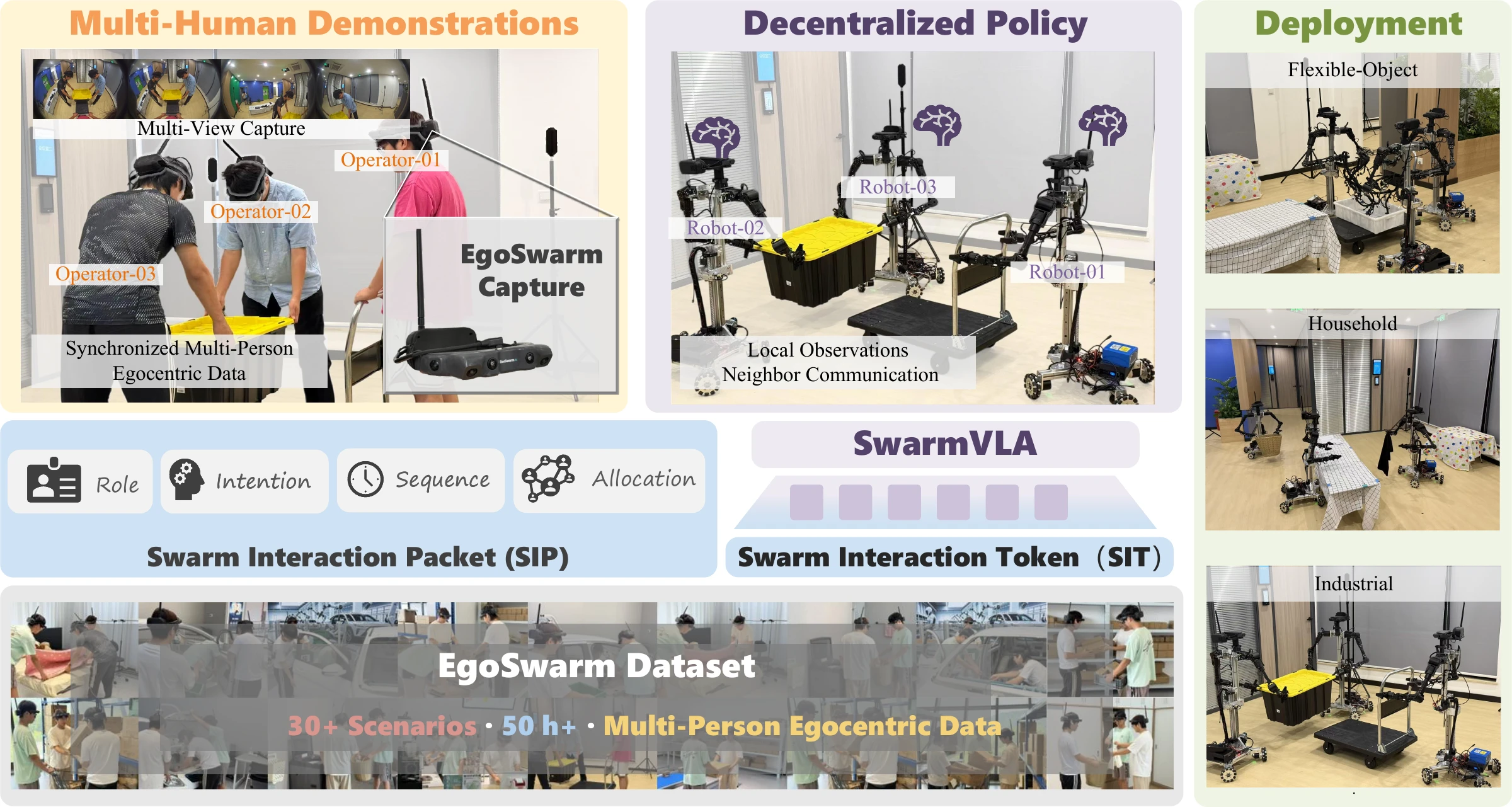
Advancing from individual embodied intelligence to swarm embodied intelligence is a key step toward scalable, general-purpose embodied intelligence. Complex tasks often require multiple agents to divide responsibilities, coordinate handovers, and manipulate shared objects collaboratively. However, existing robot learning methods rely primarily on individual demonstrations, which provide limited supervision for modeling dependencies among agent actions, while collecting multi-robot demonstrations at scale remains difficult. Human egocentric demonstrations offer a scalable alternative, yet distributed observations from multiple participants cannot directly supervise decentralized policies. We introduce EgoSwarm, the first robot learning framework for learning decentralized multi-robot collaboration from human swarm demonstrations. EgoSwarm collects more than 50 hours of collaborative experience using a robot-free multi-person egocentric system. We introduce the Swarm Interaction Packet (SIP) and Swarm Interaction Token (SIT) to recover cross-agent interaction relations from distributed observations and transform this experience into local supervision consistent with deployment-time information constraints. We further propose SwarmVLA, which transfers knowledge of swarm behavior to decentralized policies conditioned on local observations, local history, and limited neighbor messages. SwarmVLA achieves a mean success rate of 72.2% across three categories of multi-robot collaborative tasks.
System Design
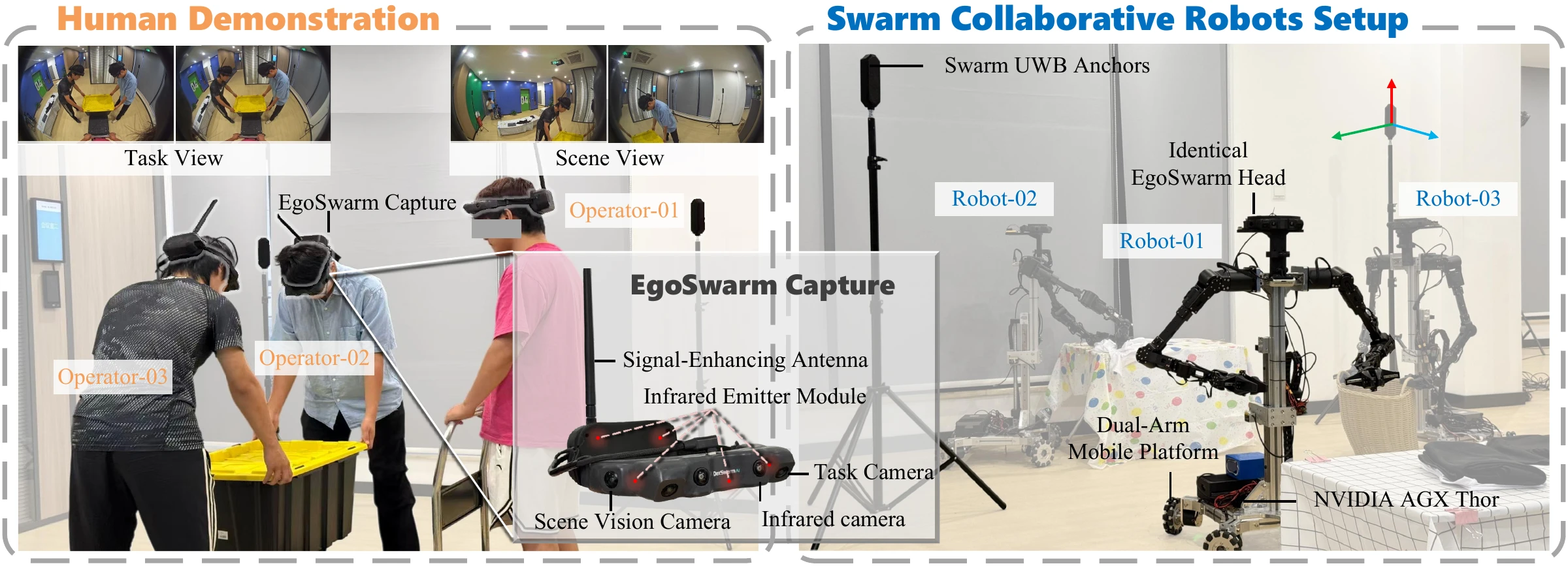
EgoSwarm Capture synchronously records multi-person egocentric demonstrations without robots during data collection. Each sensing head integrates six cameras, an IMU, and UWB sensing. The robot platform reuses the same sensing interface and independently performs perception, local interaction processing, and SwarmVLA inference on NVIDIA AGX Thor.
Training Data
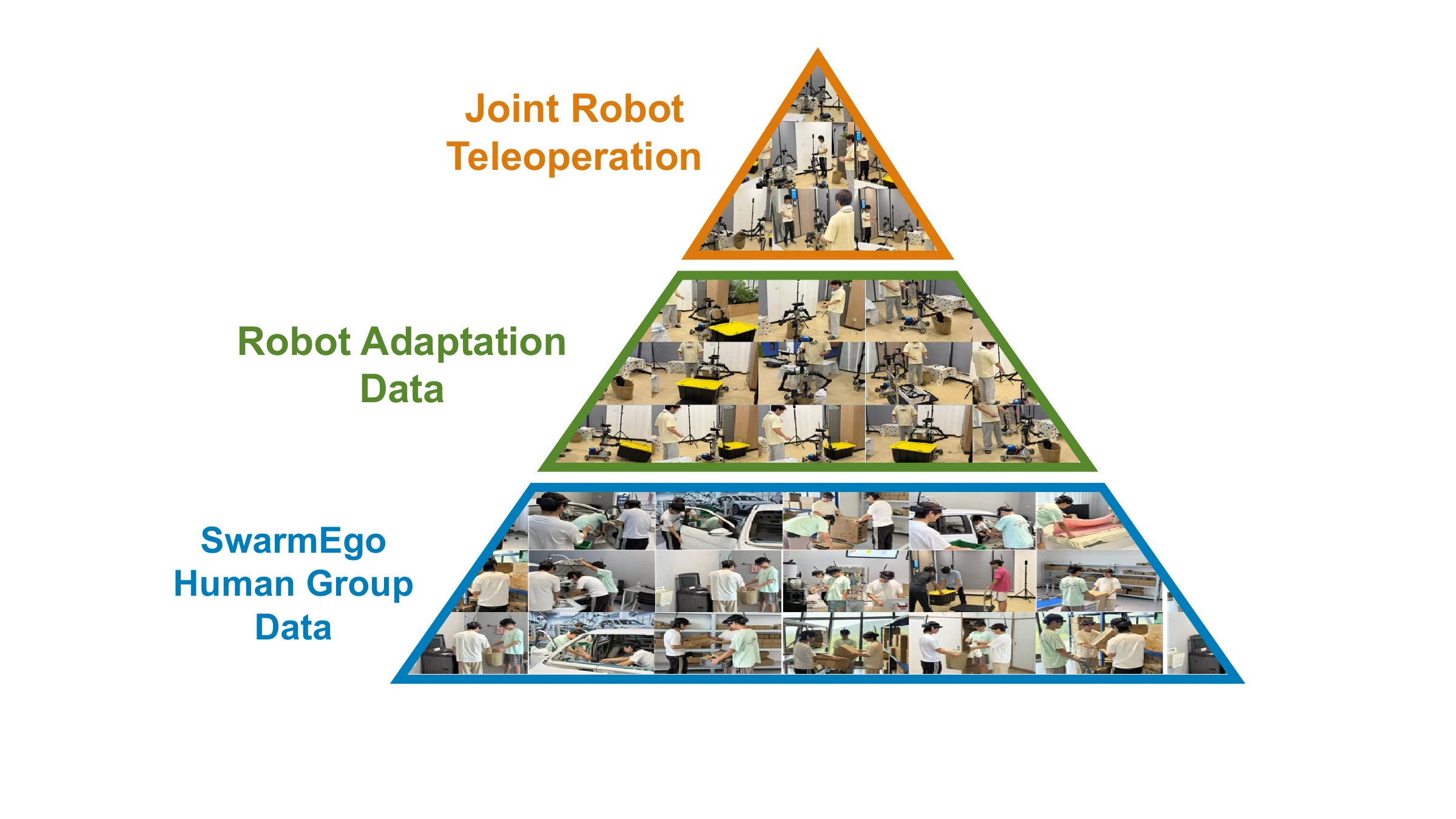
The training data consists of more than 50 hours of human collaborative experience across 30 scenario categories, robot adaptation data for embodiment alignment, and joint robot teleoperation data for task-specific action supervision.
SwarmVLA
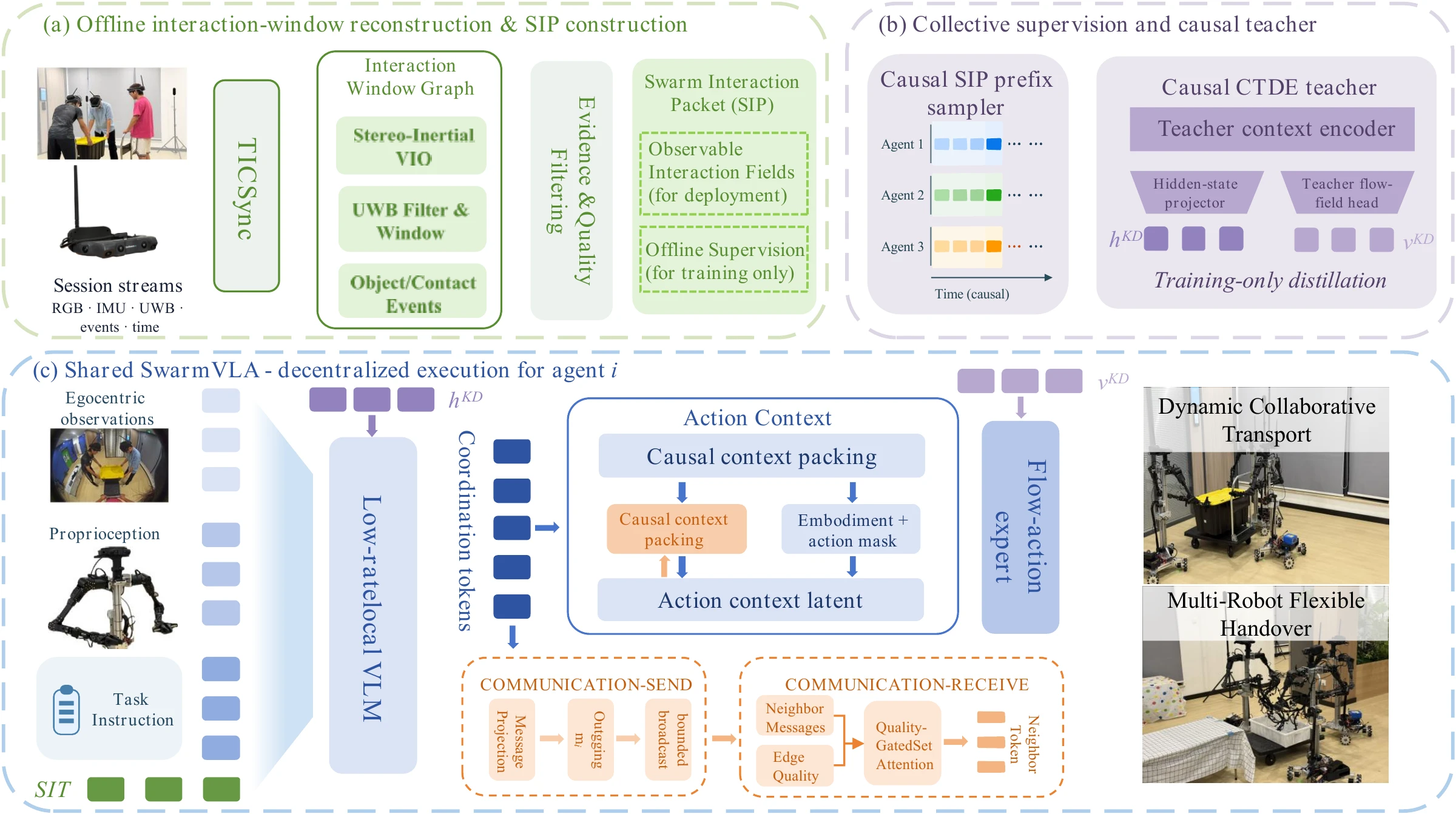
Multimodal egocentric recordings are temporally aligned and reconstructed into Swarm Interaction Packets (SIPs). A causal teacher learns from collective interaction supervision and transfers coordination representations to a decentralized student policy. During deployment, each robot constructs local Swarm Interaction Tokens (SITs) and generates actions using local observations, history, and quality-aware neighbor messages.
Autonomous Policy Rollouts
Deployment experiments are conducted across three representative tasks to evaluate decentralized multi-robot collaboration.
Multi-Robot Flexible Handover (MRFH)
Three robots sort laundry through coordinated handovers and basket loading, testing conditional handovers and temporal coordination.
80.0% success rate
Dynamic Collaborative Transport (DCT)
Two robots load a box onto a cart before a third takes over transport, testing joint support and role transitions.
73.3% success rate
Large-Scale Deformable Object Manipulation (LSDOM)
Multiple robots jointly manipulate a wire harness, testing sustained coordination through a shared deformable object.
63.3% success rate
Experimental Results
EgoSwarm achieves a mean success rate of 72.2% across three tasks, exceeding Dec-VLA-Comm by 22.2 percentage points. Each method is evaluated in 30 independent trials per task.
| Method | MRFH | DCT | LSDOM | Mean |
|---|---|---|---|---|
| Local-Rule | 20.0 | 26.7 | 10.0 | 18.9 |
| Independent VLA | 43.3 | 46.7 | 36.7 | 42.2 |
| Dec-VLA-Comm | 63.3 | 56.7 | 30.0 | 50.0 |
| Centralized Joint VLA* | 80.0 | 50.0 | 46.7 | 58.9 |
| EgoSwarm (ours) | 80.0 | 73.3 | 63.3 | 72.2 |
* Global-observation reference. Evaluation primarily uses three robots.
Ablation Studies
Communication Robustness and Runtime
66.7 %
Mean success under 30% packet loss and 100 ms additional delay .
- P95 end-to-end latency
- 38.6 ms
- Neighbor traffic per robot
- 11.8 KB/s
- Relative translation RMSE
- 4.8 mm
BibTeX
@misc{chen2026egoswarm,
  title={EgoSwarm: Learning Decentralized Robot Swarm Intelligence
         from Human Swarm Demonstrations},
  author={Xitong Chen and Ziqiang Liu and Min Li and Yiqun Li and Zhuoping Yin},
  year={2026},
  url={https://xitong-c.github.io/EgoSwarm_Page/}
}